
This is chapter 3 of the book Inspired: The A-Z of Creative Unblocking
Criticism (noun): an opinion given about something or someone, esp. a negative opinion, or the activity of making such judgments
Design studio bootcamp
Imagine this: A giant, red “REDO” stamped across your work. Professors ripping apart your printed designs with laser focus. Building models getting deconstructed and rebuilt with both fury and fascination. Rapid-fire questions that make your knees go weak.
These aren’t (just) scenes from a designer’s worst nightmare, but they were our real-life design studios! Five years of architecture school featured a whirlwind of “crits” (short for critique sessions, because architects are cool like that) that were both terrifying and strangely exhilarating.
From day one, it was drilled into us: feedback is your friend. You have to hear what people think to get better. In fact, it isn’t just about what others say. Over years of training, we also learned to develop a killer sense of critical thinking – basically, becoming our own toughest critics.
So now when I say, “Don’t listen to your Inner Critic,” a part of me screams, “Wait, isn’t that the key to growth? Shouldn’t that voice be pointing out flaws to make you think deeper?”
Untangling the critic web
The truth is, it gets complicated – because there are fine lines distinguishing the terms “criticism”, “critique”, “critical thinking”, and “the Inner Critic”. Okay, Merriam-Webster to the rescue for differentiating the first two:
“Criticism”, on the one hand, is the broad thumbs-down we get sometimes. The word is most often used to refer to “the act of negatively criticizing someone or something”. For example, “I’m more interested in encouragement right now than in criticism.” Or it could be a casual comment: “She shared a minor criticism about the design.”
“Critique”, on the other hand, is a more thoughtful breakdown. It’s defined as a carefully expressed judgement, opinion, or evaluation of both the good and bad qualities of something – say books or movies. Thus, a critic might write a critique filled with, well, criticism, but it’s likely to be delivered in a constructive way.
Now, critical thinking is a creative superpower. We use it all the time when we analyse our ideas, figuring out what works and what needs the boot. It’s like a writer being their own editor, constantly pushing the creative process forward. Critical thinking elicits the kind of judgement that elevates the creative process.
But the Inner Critic? That’s a whole different story.
The voice of doubt
This sneaky character likes to masquerade as critique or critical thinking, but it’s neither. Imagine a professor in a critique session trashing your work and your self-worth. Yikes! That’s the Inner Critic’s specialty – vicious personal attacks.
“You’re not good enough to write this book.” “Self-publishing? No way. No one will take you seriously.” “Ditch the personal diary stuff and make it more academic!”
Looking back, I can see how my Inner Critic has been my constant shadow, throwing roadblocks on my creative path for over a decade. And I wonder…does this sound familiar to you as well?
A voice that pretends to be the more “cautious” side of you. A voice that comes up with a dozen different reasons to NOT do something new. A voice that reminds you ONLY of your setbacks – and tells you it’s outrageous to dream too big. If you can relate, then I know you’ve stood face-to-face with your Inner Critic.
Whether you’re crafting cutting-edge tech solutions or creating mind-blowing art, creative thinking is the fuel. And the Inner Critic? It’s the ultimate roadblock. Why? Because deep down, it doesn’t understand creativity. It’s simply fear in disguise. As our voice of fear, it loves to paralyze us before we even take a step towards our audacious goals. It’s not just an emotional downer, but it actively interferes with our projects, explorations, and career progression.
Fear under the microscope
Speaking of fear, let’s unpack this beast.
The amygdala is a component of our brain which functions like a smoke detector. Back in the good ol’ caveman days, it kept us safe from hungry tigers and unpredictable weather. Today, it might warn you against a deep-sea diving adventure or losing your prestigious job title. Fear is definitely a friend in those moments, and the amygdala does its job well. Like a protective parent, it tries to shield us from “stressors” like uncertainty, change, and struggle.
However, here’s the twist: those same stressors that trigger fear in really dangerous situations are also the stepping stones to growth. Every healthy challenge comes with a side of uncertainty, change, and struggle. Unfortunately, our primitive brain (the fear centre) can’t tell the difference between a career-defining risk and, well, jumping off a cliff. Both trigger the same fear response.
Yet, in real life, we definitely know that a good challenge isn’t the same as facing down a mountain lion.
Not all fears are created equal
Take a look at Dr. Karl Albrecht’s model of hierarchy of fears.
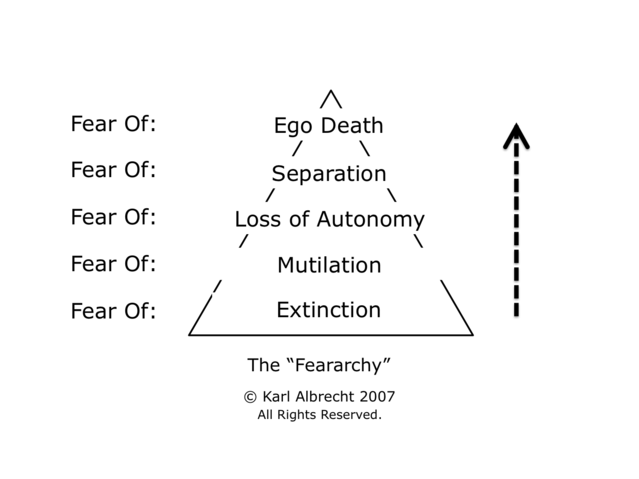
The model categorizes every human fear on a scale ranging from “existential dread” (like fear of extinction) all the way down to “cold feet” (like ego death during public speaking, maybe?). Basically, some fears keep us alive, while others are just learned reflexes we can weaken or even unlearn. Creative fear, in particular, often stems from the fear of rejection. After all, creativity disrupts the status quo, which can feel a bit like social suicide to our primal selves. It’s a kind of learned “ego death” that, thankfully, can be unlearned.
For me, understanding fear and mind blocks has been a game changer. Everything in this book is a reminder to myself (and maybe you too!) to keep evaluating these creative fears and not let them drown out our creative spirit.
Befriending the beast
Remember, fear is information. It’s trying to be helpful, like a nervous friend whispering warnings. But fear is also a knee-jerk reaction sometimes, and what’s safe and what’s dangerous depends entirely on the situation. The Inner Critic – bless its overprotective heart – just wants to “save us” even before it’s had a chance to consider the whole picture. So it’s up to us to analyse the situation, figure out if it’s a real threat or just a healthy challenge, and then act accordingly.
The next time your Inner Critic whispers negativity, remember: it’s just fear, loud and out of control.
We can learn to listen, but we don’t have to obey.
Interested in more such conversations on creativity?
Get your own copy of ‘Inspired: The A-Z of Creative Unblocking’, by Nishita Mohta
 nishita mohta